Shop All Bikes
Check Out Our Popular Ebikes


Start with the routes you ride most. A bike that feels right on packed gravel and maintained forest roads may be a poor match for loose sand, rocky climbs, or root-covered trails.
Before comparing models, note the surface you ride, how rough it gets, how much climbing you expect, the distance of a typical outing, and how you will transport the bike. Those details provide a more useful starting point than a single motor, tire, or range figure.
Off-road covers very different riding conditions. A maintained gravel road, a loose forest path, a sandy beach route, and a rooty trail are all unpaved, but each asks something different from an e-bike.
Start by separating light off-road riding from technical trail riding. Gravel roads, maintained forest roads, and uneven paths fall into the first group. Repeated roots, rocks, steeper grades, and rough descents fall into the second. A bike that suits light off-road riding is not necessarily built for demanding technical terrain.
For gravel roads, dirt paths, and maintained forest routes, prioritize stable handling, suitable tires, dependable brakes, and front suspension where the surface is consistently uneven. Sand, snow, and soft ground call for more tire volume and traction. Rougher routes place more emphasis on suspension, braking, tire grip, and rider control.
Before comparing models, write down five details about a typical ride:
Use this list as you compare bike categories and specifications.
Most off-road e-bike buyers are choosing among a fat-tire all-terrain e-bike, a hardtail electric mountain bike, and a full-suspension e-MTB. These formats overlap, but each one is built around a different balance of comfort, control, weight, and maintenance.
A bike that feels comfortable on gravel roads or loose dirt may feel less controlled on repeated roots and rocks. On the other hand, a bike designed for rougher technical riding can bring extra weight, cost, and suspension complexity that are unnecessary for casual forest roads or light trails.
Choose a fat-tire e-bike when loose dirt, sand, snow, uneven paths, or mixed-surface routes make up a regular part of your riding. The larger tire volume provides a broader footprint on soft ground and adds cushioning over broken surfaces.
For rougher terrain, tire width is only one part of the decision. Brakes, suspension, bike weight, geometry, and rider fit have a larger influence on how controlled the bike feels over repeated rocks, roots, and descents.

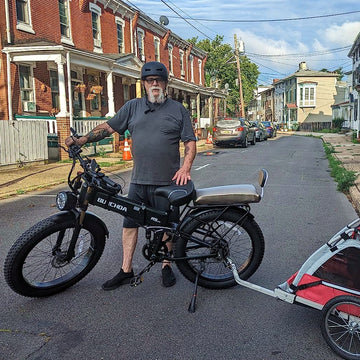
The Burchda HC26 AWD off-road e-bike brings together 26 x 4.0-inch fat tires, front and rear suspension, hydraulic disc brakes, and a 48V 30Ah battery for riders who regularly encounter loose ground and uneven mixed-surface routes. Its current U.S. configuration has a listed bike weight of 79.8 pounds and a maximum load of 500 pounds. Before ordering, make sure your vehicle rack, storage space, rider-and-gear load, and regular routes are compatible with the model. Specifications and availability may change, so review the product page for the latest details.
A hardtail e-MTB pairs a suspension fork with a rigid rear frame. This format works well for gravel roads, hard-packed dirt, forest roads, and moderate trails where front-wheel control matters more than rear-suspension travel.
The simpler frame layout means fewer suspension parts to service. On smoother routes, a hardtail often feels efficient and direct. On repeated roots and rocks, however, the rear wheel and rider absorb more impact than they would on a full-suspension bike.
A full-suspension e-MTB uses both a suspension fork and a rear shock. Choose this layout when your usual rides include repeated roots, rocks, rough descents, or uneven ground that repeatedly unsettles the rear wheel.
The rear suspension helps manage impacts and maintain tire contact, but it also adds weight, cost, and additional service needs. For smoother gravel, maintained dirt roads, and light trails, a hardtail or all-terrain fat-tire e-bike may be easier to own and more than capable for the route.
Recommended reading: Hardtail vs. Full Suspension E-MTB: Which Should You Choose?
An off-road e-bike should fit your body and your regular riding needs. A powerful motor or wide tires cannot compensate for a frame that feels too large, too cramped, too heavy to handle, or difficult to control over uneven ground.
Start with the manufacturer’s sizing guidance. Then look at standover height, reach to the handlebars, and your position when seated and standing on the pedals. You should be able to mount and dismount with confidence, steer without overreaching, and move your weight as the surface changes.
Also consider total loaded weight, not just your body weight. Check how the product page defines its payload or maximum-load figure. Unless otherwise stated, account for the rider and everything carried on the bike, including clothing, water, tools, locks, bags, accessories, and cargo.
Think through what happens before and after the ride, too. A heavier e-bike takes more effort to lift onto a hitch rack, carry upstairs, load into a vehicle, or move with a depleted battery. Confirm the complete-bike weight, battery-removal method, storage dimensions, and rack capacity before placing an order.

A step-through frame is worth considering if mounting and dismounting is a regular concern. The Burchda C35 AWD off-road e-bike uses a step-through frame with a listed 20-inch standover height, full suspension, fat tires, and a maximum load of 500 pounds. Review the current product page for complete-bike weight, included equipment, and the latest U.S. configuration before confirming that the bike fits your storage and transport setup.
Once you know the bike style and weight you can manage, look at the motor and battery. Motor placement, rated power, peak power, torque, gearing, tire traction, and battery capacity influence different parts of the ride, from low-speed climbing to how much energy is available for a longer route.
A hub motor sits inside a wheel hub, most often at the rear. Hub-drive e-bikes are common on all-terrain, fat-tire, and mixed-surface models. They suit gravel roads, forest paths, and light off-road routes when the tires, brakes, gears, and bike weight match the riding conditions.
A mid-drive motor sits near the pedals and sends power through the bike’s drivetrain. Because the motor works through the selected gear, shifting to a lower gear can help the system operate more effectively as the terrain steepens. Compare the two layouts based on your usual climbs, total load, available gear range, and maintenance preferences.
Motor power is usually listed in watts. Product pages may show a rated or nominal power figure, a peak-power figure, or both. Rated power generally refers to a sustained specification, while peak power refers to a higher output that may be available temporarily under specific conditions.
Do not compare a peak-power figure on one bike directly with a rated-power figure on another. Climbing performance also depends on gearing, motor behavior, rider input, surface traction, total weight, gradient, and assist level.
Torque, measured in Newton-meters (Nm), describes twisting force. On an e-bike, torque affects how the motor responds when starting, accelerating, or climbing at lower speeds. Use it as one comparison point alongside motor type, sensor behavior, gearing, and the terrain you ride.
Battery capacity is commonly expressed in watt-hours (Wh), a measure of stored energy. When comparing battery sizes, Wh gives a clearer comparison than amp-hours (Ah) alone because it reflects both voltage and capacity.
A higher-capacity battery stores more energy and often adds weight. Check the listed battery and complete-bike weights rather than estimating them from Wh alone. Actual range changes with terrain, elevation gain, rider and cargo weight, tire pressure, assist level, speed, temperature, and riding style. Use any listed range as a manufacturer estimate, especially for hilly or rough routes.
A removable battery can make indoor charging, storage, and transport easier. Before ordering, check the listed battery capacity, removal method, charging instructions, and replacement-battery availability for the model you are considering.
Motor assistance helps cover more ground, but tires, suspension, brakes, and gearing determine much of how the bike behaves on uneven surfaces. Review these parts before giving too much weight to speed-related specifications.
Tires shape traction, comfort, steering, and the way an e-bike responds to loose or uneven surfaces. For gravel, dirt roads, and light trails, choose a tread pattern that fits the surface you ride most. Knobbier tread improves grip on loose dirt or mud, while smoother tread rolls more efficiently on hard-packed paths and pavement.
Wider tires add comfort and stability on loose ground. Fat tires are particularly useful on soft surfaces such as sand or snow, although they add rolling resistance and weight. Select tire width for your regular terrain rather than treating it as a universal sign of off-road capability.
Tire pressure also affects grip and comfort. Lower pressure can improve traction over loose surfaces, while pressure that is too low raises the chance of tire damage or unstable handling. Stay within the pressure range stated by the tire and rim manufacturers.
Wheel size changes the bike’s handling character. Smaller wheels often feel more responsive, while larger wheels roll over some obstacles more smoothly. Frame fit, tire size, and route conditions matter more than wheel diameter by itself.
A suspension fork absorbs impacts at the front wheel and helps it track uneven ground. For gravel roads, forest paths, and moderate off-road routes, front suspension often provides the comfort and steering control riders need.
Full suspension adds a rear shock to manage repeated impacts on rougher surfaces. It is most useful on routes with regular roots, rocks, and uneven descents, where the rear tire benefits from more consistent ground contact. It also brings more moving parts, additional weight, and routine service needs.
Off-road e-bikes are often heavier than non-electric bikes, and uneven terrain places more demand on braking control. Hydraulic disc brakes generally require less lever effort and provide more progressive braking control than mechanical disc brakes when both systems are properly adjusted and maintained.
Review the brake type, rotor size, and replacement-pad availability for the specific bike. Check pads and rotors regularly, particularly after muddy, wet, or extended downhill riding.
Gearing matters when the route changes pitch. A wider gear range and lower gears help you maintain a steady pedaling cadence on climbs rather than relying only on a high assist level. Shift into an easier gear before the climb steepens, then select an assist level that supports your effort without using more battery than necessary.
Before choosing an off-road e-bike, compare models against the way you actually ride:
The goal is to choose an e-bike whose fit, handling, motor system, battery capacity, and components support the rides you plan to take.
Use this checklist to compare Burchda off-road e-bikes by the details that affect daily ownership: terrain, frame fit, bike weight, load capacity, battery size, tires, suspension, brakes, and storage needs. The right choice is the model that fits the routes you ride and the way you transport, store, and use your e-bike.
Fat-tire e-bikes work well for riders who regularly encounter loose dirt, sand, snow, or uneven mixed-surface routes. Their larger tire volume creates a broader contact area and adds cushioning over softer or broken ground.
For rocky, rooty, or steep terrain, look beyond tire width. Braking performance, suspension, bike weight, frame geometry, and rider skill all affect how controlled the bike feels.
Full suspension makes the most sense when rough terrain is a regular part of your riding rather than an occasional section of an otherwise smooth route. Repeated roots, rocks, and uneven descents are situations where a rear shock can improve comfort and help the rear tire maintain contact with the ground.
For gravel roads, maintained forest roads, and moderate trails, a hardtail often provides enough front-end control with fewer moving parts to maintain.
Start with the distance and climbing on a typical ride, then account for soft surfaces, rider-and-gear weight, and your usual assist level. Compare battery capacity in watt-hours because Wh reflects stored energy more clearly than amp-hours alone.
Use a published range figure as a reference point, then leave reserve capacity for return travel. Steep climbs, loose terrain, high assist levels, cold weather, and extra cargo can all reduce the distance you cover on one charge.