Shop All Bikes
Check Out Our Popular Ebikes


Choosing an e-bike can get complicated fast. Motor power, battery range, tire size, and suspension all matter, but the frame style affects something even more basic: how the bike feels every time you get on, stop, and ride.
That is where the step-over vs. step-through e-bike decision comes in. A step-through e-bike makes it easier to mount, dismount, and handle everyday riding. A step-over e-bike uses a more traditional frame shape that many riders prefer for rougher terrain, hill climbing, and performance-focused riding.
Neither option is automatically better. The right choice depends on where you ride, how often you stop, how much gear you carry, and what feels comfortable for your body.
This guide compares step-through and step-over e-bikes in practical terms, so you can choose a frame that fits your everyday riding needs.

A step-through e-bike has a low or open frame area between the saddle and the handlebars. Unlike a traditional bike with a high top tube, a step-through design gives you more space to step into the bike instead of swinging a leg over the frame or rear wheel.
You may also see this style called a low-step, step-thru, or open-frame e-bike. The names vary, but the purpose is the same: make mounting and dismounting easier.
The lower entry point changes how you interact with the bike before and after each ride. That is why step-through frames are popular for commuting, errands, casual rides, and other practical daily uses.
Step-through e-bikes are not limited to any one age group or gender. They are simply a practical choice for riders who value accessibility, comfort, and convenience.
The trade-off is that a lower, more open frame may use a different reinforcement strategy than a traditional triangle frame. That does not make it a weaker choice by default, but it does make the overall bike design worth comparing more closely.
A step-through e-bike is built around easy access and everyday convenience. Its main benefits are most noticeable during commuting, errands, casual rides, and other situations where you get on and off the bike often.
The most obvious benefit of a step-through e-bike is easier access. You can step into the frame instead of lifting your leg over a high top tube or swinging it behind the saddle.
That small difference becomes more noticeable in daily riding. It helps when you stop at traffic lights, park outside a store, or need to get on and off the bike several times during a commute.

A low-step frame can reduce the range of motion needed to mount and dismount. That can help riders with limited hip, knee, or back mobility, as well as anyone who prefers a more controlled way to get on the bike.
It is not about age or gender. It is about choosing a frame that feels comfortable and confidence-inspiring every time you ride.
Step-through e-bikes are a natural fit for commuting, neighbourhood rides, errands, and relaxed weekend trips. Many riders appreciate the easy access when they are wearing everyday clothes or carrying a backpack.
The frame alone does not determine comfort, but it can make the overall riding experience feel less demanding. A well-fitted low-step e-bike lets you focus more on the ride and less on getting on and off.
Riders who want to explore more options for commuting and casual riding can browse Burchda's commuter electric bikes.
Rear racks, panniers, baskets, and child seats can make a bike more useful, but they can also make it harder to swing a leg over the back of a traditional frame. A step-through design keeps the middle of the bike open so that you can avoid that awkward movement.
This is especially practical for grocery runs, commuting with work gear, or family rides where the rear rack is already in use.
You should not need to change your outfit to ride across town. A step-through e-bike works well with casual clothes, workwear, longer coats, and other outfits that may limit a high leg swing.
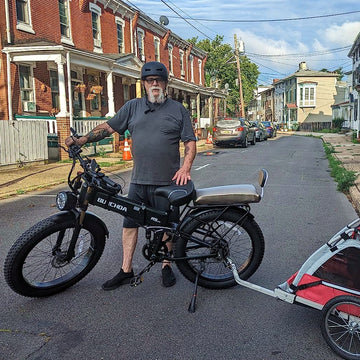
For riders who want a low-step fat-tire model for commuting, casual rides, and everyday transportation, the Burchda U8 step-through e-bike is worth considering.
A step-through frame may require extra reinforcement to match the stiffness of a traditional high-step design, which can add weight on some models. For aggressive trail riding, fast cornering, or high-impact terrain, riders may prefer the more performance-oriented feel of a step-over frame.
The open frame design can also leave less room for center-mounted accessories such as triangle frame bags. In those cases, rear racks, front baskets, and handlebar bags are often the more practical storage options.
A step-over e-bike uses the traditional bicycle frame design with a higher top tube running between the front of the bike and the seat area. To get on, you typically swing one leg over the top tube or behind the saddle.

You may also see this style called a high-step, diamond-frame, or traditional-frame e-bike. Its familiar triangle-shaped structure has been used on bicycles for decades.
This frame style is common on traditional bicycles and many mountain, fat tire, and all-terrain e-bikes. Riders who prefer a more active riding position and a conventional bike feel often choose it.
A step-over frame is not automatically the right option for every rider. It requires more clearance and flexibility to mount and dismount, which can be less convenient in city traffic or when carrying cargo on a rear rack.
A step-over e-bike is often preferred by riders who want a more traditional frame feel and a bike suited to active riding. Its advantages become more relevant on hills, rougher routes, longer rides, and performance-focused terrain.
A step-over e-bike uses the classic triangle frame found on many bicycles. This design places a top tube between the front and rear sections of the frame, creating a structure that many riders recognize and trust.
When materials and frame geometry are comparable, this design can provide a more direct and solid riding feel. Riders may notice that difference when pedalling hard, climbing hills, or riding over uneven surfaces.
Step-over e-bikes are often a strong match for riders who want more than casual pavement riding. They are commonly used for long rides, hill climbing, gravel paths, forest roads, and more demanding terrain.
The traditional frame shape can feel more planted when you stand on the pedals, shift your weight through turns, or ride over rougher ground. That makes it a popular choice for riders who want a more active and connected riding experience.
Many high-performance fat tire and all-terrain e-bikes use a step-over frame. The design pairs naturally with larger tires, suspension systems, hydraulic brakes, larger batteries, and more powerful motor setups.

For example, riders looking for more capability on hills, loose gravel, or unpaved routes may prefer a step-over model such as the Burchda HC26 AWD. Its dual-motor AWD system, 26 × 4.0-inch fat tires, front and rear suspension, and hydraulic brakes support a more rugged riding focus.
To compare more models built for rougher routes, hills, and outdoor exploration, browse Burchda's off-road electric bikes.
The open triangle inside a step-over frame can create useful space for accessories. Depending on the model, riders may be able to add a frame bag, water bottle cage, tool pouch, or other gear for longer rides.
That extra storage can be useful for trail riding, camping trips, extended commutes, or any ride where you want to carry essentials without relying only on a rear rack.
A step-over frame requires you to lift your leg over the top tube or saddle area, which can be less convenient for shorter riders, people with limited flexibility, or anyone riding a heavier e-bike. It can also feel less practical in stop-and-go traffic, where you may need to get on and off the bike several times during a commute.
Rear cargo can add another challenge. If you use a rear rack for a large bag, groceries, or a child seat, there may be less room to swing your leg over the bike comfortably.
| Feature | Step-Through E-Bike | Step-Over E-Bike |
|---|---|---|
| Frame design | Low or open frame area for easier access | Traditional frame with a higher top tube |
| Getting on and off | Easier to mount and dismount | Requires swinging a leg over the frame or saddle |
| Best for daily riding | Commuting, errands, casual rides, and frequent stops | Longer rides, hills, trails, and active riding |
| Mobility needs | A practical choice for riders who want less leg movement when mounting | Better suited to riders who are comfortable clearing a higher frame |
| Stop-and-go traffic | More convenient when stopping often | Less convenient when getting on and off repeatedly |
| Cargo use | Easier to access when a rear rack is loaded | Rear cargo can make mounting more difficult |
| Riding feel | Often focused on comfort and accessibility | Often feels more traditional and performance-oriented |
| Frame accessories | Less center-frame space for triangle bags | More room for frame bags and some mounted accessories |
| Typical e-bike setup | Commuter, comfort, utility, and casual fat tire models | Mountain, all-terrain, performance, and fat tire models |
The biggest difference is not simply how the bikes look. It is how the frame supports your normal riding routine. A step-through e-bike makes daily access easier, while a step-over e-bike may better suit riders who prioritize a traditional frame feel, rougher terrain, and more active riding.
Still comparing different frame styles and riding categories? Explore Burchda's full range of electric bikes.
The right frame is not based on age, gender, or appearance alone. Think about where you ride most, how often you stop, how much gear you carry, and how comfortable you feel mounting and dismounting the bike.
A step-through e-bike is often the better choice if most of your rides involve commuting, running errands, cruising around your neighbourhood, or making frequent stops. It is also a practical option if you want an easier way to get on and off the bike, especially when you are carrying a backpack, groceries, or other cargo.
If comfort and everyday convenience matter more than aggressive trail performance, a low-step frame can make riding feel simpler from the start. You do not have to plan every stop around swinging a leg over the saddle, which can make a real difference when you ride regularly.
The Burchda U8 is a practical option for riders who want a low-step, fat-tire e-bike for city riding, bike paths, and light unpaved routes.
A step-over e-bike may be a better match if you spend more time on hills, gravel, forest roads, rough trails, or longer outdoor rides. It is also a good option for riders who prefer a more traditional frame feel and want a bike designed around all-terrain capability.
For demanding routes, look beyond frame style and consider the complete setup. Fat tires, suspension, braking power, motor output, battery capacity, and payload rating all play a bigger role in how an e-bike handles real-world terrain.
For riders seeking a more performance-focused, dual-motor, fat-tire e-bike, the Burchda Y3 AWD is another high-step model to compare. Before riding any high-powered e-bike on public roads, always check your local and state e-bike regulations, since speed and classification rules vary by location.
Frame style matters, but it is only one part of choosing the right e-bike. Bike fit, weight, payload capacity, tires, brakes, suspension, and motor setup can have just as much impact on your daily riding experience.
Your height is a useful starting point, but it should not be the only measurement you use. Before choosing a frame, check the bike's standover height, seat height range, reach to the handlebars, and your inseam.
A step-through frame may be easier to mount, but it still needs to fit your body correctly. A step-over frame can work well for shorter riders too, as long as the standover height and seat position feel comfortable.
If possible, test ride the bike before buying. If that is not an option, review the sizing chart carefully and compare it with your own measurements.
E-bikes, especially fat tire models with larger batteries, can be much heavier than standard bicycles. Think about how easily you can park, push, turn, and control the bike at low speed.
Payload capacity matters too. Your weight, clothing, backpack, rear-rack cargo, and any accessories all count toward the bike's total load. If you plan to carry groceries, camping gear, or a child seat, check the manufacturer's payload rating before you buy.
The right components depend on where you ride most often. For commuting and casual rides, comfort, predictable braking, practical range, and stable tires may matter most.
For hills, gravel, trails, and uneven surfaces, focus more on tire traction, suspension travel, hydraulic brakes, motor power, and battery capacity. A high-step frame alone does not make an e-bike trail-ready, just as a low-step frame does not prevent a bike from handling light off-road routes.
For long-term performance, follow these fat tire e-bike maintenance tips before and after demanding rides.
Think about the rides you will take most often, not only the occasional adventure ride. If most of your trips involve bike paths, city streets, errands, and frequent stops, a step-through e-bike may be the more useful everyday choice.
If most of your rides involve rough terrain, climbs, longer distances, or outdoor exploration, a step-over e-bike may better match your needs. Choose the frame and components that support the way you actually plan to ride.
Choose a step-through e-bike if easy mounting, everyday comfort, commuting, and frequent stops are your top priorities. The Burchda U8 is a practical option for riders who want a low-step, fat-tire e-bike for daily transportation and relaxed rides.
Choose a step-over e-bike if you prefer a traditional frame feel and spend more time on hills, gravel, trails, or other demanding terrain. For all-terrain and performance-focused riding, consider the Burchda HC26 AWD or Y3 AWD.
The right choice comes down to how and where you ride most often.
No. Step-through e-bikes are for anyone who wants easier mounting and dismounting. They are popular with commuters, casual riders, parents carrying cargo, and riders with limited flexibility.
Not necessarily. A traditional step-over frame can be more naturally rigid, but well-designed step-through e-bikes use reinforcement to provide reliable everyday performance. Frame quality and overall bike design matter more than frame style alone.
A step-through e-bike is usually more convenient for commuting because it is easier to get on and off in traffic or at frequent stops. A step-over e-bike can also work well if your route includes hills, rough roads, or longer distances.
Step-over frames are more common on mountain, fat tire, and all-terrain e-bikes because they often suit a more active riding style. Still, off-road performance depends on the tires, suspension, brakes, motor, and overall frame design.
Yes, as long as the rear rack and total bike payload are rated for the load. Always check the manufacturer's cargo limits and child-seat compatibility before adding accessories.
They can make mounting and dismounting easier, but frame fit still matters. Check the bike's standover height, minimum seat height, and reach to the handlebars before choosing a model.
Neither frame style is automatically safer. A step-through frame can feel more secure for frequent stops, while a step-over frame may feel more stable for performance-focused riding. The safest choice is a properly fitted e-bike with reliable brakes, suitable tires, and a riding style that matches your experience.