Shop All Bikes
Check Out Our Popular Ebikes


Most folding e-bike guides chase one thing: how small and light a bike can get. That focus skips over riders who need real power, stable handling on rough terrain, and a battery that won't quit halfway through the ride.
This guide is built for that rider. It covers what actually matters in a high-performance folding electric bike for 2026: motor strength that handles hills and cargo, battery range that holds up in real conditions, and a fat-tire, foldable frame tough enough for daily use, not just occasional trips.
Whether you're commuting across mixed terrain, storing a capable e-bike in an RV, or simply tired of underpowered folders, the sections ahead offer clear, practical guidance, not a chase for the lightest possible frame.
Space is the real constraint for most adult riders today. Apartments, shared parking, and RVs simply weren't designed around full-size bikes, and a folding frame turns "no room for a bike" into a non-issue. Slide it into a car trunk, tuck it behind a closet door, or store it in an RV cabinet without giving up floor space every day.

Commuting habits have shifted, too. Mixing a train ride with the last mile on two wheels, or parking the car farther out to skip traffic, only works if the bike collapses down enough to be carried on board or lifted into a trunk without a struggle. A folding electric bike removes that friction, turning a rigid commute into something flexible.
Fits into tight storage: apartments, offices, RVs, and car trunks all become viable parking spots.
Supports multi-modal travel: pairing a bike with a train, bus, or car cuts commute time without adding a second vehicle.
Lowers transportation costs: short trips that once required a car become easy on two wheels, with less fuel, parking, and maintenance expense over time.
Adapts to changing needs: the same bike works for a Monday commute and a Saturday trail ride, without needing two separate bikes.
For adults who want power and durability without sacrificing the ability to store or transport the bike easily, a folding design isn't a compromise. It's what makes a capable, high-performance e-bike practical for everyday life.
Picking the right folding electric bike starts with an honest look at how you'll actually use it, not which model has the most followers on social media. The steps below walk through the factors that separate a bike that performs for years from one that gets abandoned in a garage after a few months.
Before comparing specs, get clear on the riding you'll actually do. Daily city commuting calls for different priorities than weekend trail rides or RV-based travel. A bike built for smooth pavement will struggle on gravel or sand, while a heavier, off-road-capable folder may feel like overkill for a short, flat commute. Matching the bike to the terrain, distance, and frequency of use prevents both overspending and underperformance.
Folding frames vary widely in how they collapse and how well they hold up over time. Mid-fold designs split the frame at a central hinge, while tri-fold and compact frames fold the handlebars, pedals, and frame separately for a smaller footprint. What matters most is the quality of the hinge and locking mechanism, since a loose or worn joint affects both safety and ride stability.
Weight is the other half of this equation. A folding e-bike that's too heavy to lift up a flight of stairs or into a trunk defeats its own purpose, but riders who prioritize power and off-road capability should expect a heavier build than an ultra-light commuter folder. The right weight isn't the lowest number available; it's the heaviest weight you can comfortably manage for your specific storage and transport needs.

Motor wattage determines how a bike performs under real conditions, not just on a flat test track. A higher-wattage motor handles hills, headwinds, and added cargo weight without straining, while underpowered motors can feel sluggish the moment terrain gets challenging. Riders who are heavier, carry gear, or frequently face inclines should prioritize motor strength over marginal weight savings elsewhere on the bike.
Speed and assist levels should also match local regulations and your comfort level. Higher top speeds are only useful if the frame, brakes, and tires are built to handle that speed safely.
Battery specs listed in watt-hours (Wh) or amp-hours (Ah) sound straightforward, but real-world range depends on rider weight, terrain, temperature, and assist level used. A battery rated for a certain range under ideal lab conditions often delivers noticeably less on hilly terrain or in cold weather.
For commuting, match battery capacity to round-trip distance with a comfortable buffer. For longer rides or travel use, prioritize higher-capacity batteries and check whether the battery is removable, since charging a battery indoors is often more convenient than charging the entire bike near an outlet.
Wheel size and frame geometry directly affect ride comfort and stability. Larger wheels tend to roll more smoothly over bumps and uneven surfaces, while smaller wheels fold down tighter but can feel less stable at higher speeds. Suspension, whether front fork, rear shock, or a suspension seatpost, makes a meaningful difference on anything rougher than smooth pavement.
Braking systems matter just as much as motor power. Hydraulic disc brakes offer stronger, more consistent stopping power than mechanical disc brakes, which becomes especially important on a heavier, higher-speed folding e-bike. Lights, reflectors, and fenders round out the features that keep daily riding safe and practical.
Folded dimensions listed by manufacturers only tell part of the story. Before buying, check whether the folded size actually fits your trunk, RV storage compartment, or closet space, accounting for handlebars and pedals that may still stick out even when folded.
Carrying comfort matters too. A built-in carrying handle and balanced weight distribution make a noticeable difference when lifting a heavier, higher-power folding e-bike, compared to models with no thought given to how they'll be picked up and moved.
Before finalizing a decision, run through these questions:
How far do you ride on a typical day, and does the battery comfortably cover that distance with a buffer?
Where will you store the bike when folded, and does it actually fit that space?
How much weight are you comfortable lifting and carrying on stairs or into a trunk?
Do you ride mainly on paved roads, or do you need a bike that handles mixed or rough terrain?
What is your realistic budget once accessories, a helmet, and a lock are factored in?
Skipping these questions is how riders end up with a bike that looks great in photos but doesn't match their daily reality.
Not every folding electric bike is built for the same rider. Understanding the main categories helps narrow the search before comparing individual models, since each type trades off weight, power, and comfort differently.
These bikes prioritize a small folded footprint and features suited to daily city riding: fenders, integrated lights, and a rack for carrying a bag or laptop. Weight sits in a moderate range, light enough to manage but not stripped down to the bare minimum. They work well for office commutes, errands, and short-to-medium rides on paved roads.
Riders who value a smooth, predictable ride over raw power tend to gravitate toward this category. The tradeoff is limited capability once pavement turns to gravel, sand, or steep, sustained climbs.
This category shaves weight and simplifies the folding mechanism for riders who carry the bike often, up stairs, onto trains, or into an office multiple times a day. Frames tend to be smaller, batteries more modest, and components pared back to keep total weight low.
The benefit is ease of handling. The cost is reduced motor power and shorter range compared to heavier, more capable builds, making this category better suited to short, frequent trips than long or demanding rides.
Built for adults who need more than pavement performance, this category combines a stronger motor, larger battery, and wide, grippy tires with a folding frame. Fat tires improve traction and stability on sand, gravel, and uneven trails, while added frame reinforcement supports the extra weight of a larger battery and motor.
These bikes weigh more and fold into a larger footprint than commuter or lightweight models, but that tradeoff buys real capability: confident handling on rough terrain and enough power to carry cargo or a heavier rider without straining. Adults who split their riding between city streets and less predictable terrain fit this category best. One representative model in this space is covered in detail below.
Designed around extended range rather than daily commuting, this category features larger battery packs, more comfortable riding geometry, and often stronger cargo capacity. Riders planning multi-day trips, RV-based travel, or long recreational rides benefit from the added range, even if it means a bulkier fold.
Storage still matters here, so these bikes are typically evaluated against RV cabinet space or vehicle trunk dimensions rather than apartment closets. For adults who prioritize distance and comfort over ultra-compact folding, this category offers the most practical balance.
For riders who landed on "high-power fat-tire folder" in the categories above, the R5 PRO is what that category looks like in practice, built for terrain and payload, not minimal weight.
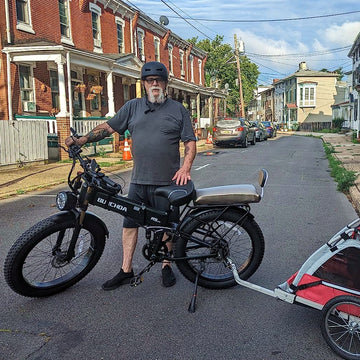
Burchda R5 PRO suits riders who split time between city streets and rougher terrain: sand, gravel, hills, or unpaved trails. It also fits riders needing serious payload capacity, whether from body weight, cargo, or both, who still want a bike that folds down for storage in a car, apartment, or office corner.

Three motor tiers are available: 1500W peak (85 Nm), 3000W dual-motor (150 Nm), and a flagship 5000W (210 Nm). Even the base model hits top speed in about 10 seconds and climbs grades up to 35 degrees. Payload capacity runs 400 lbs on the 1500W version and 500 lbs on the 3000W and 5000W models.
The standard 48V 20Ah battery (960Wh) delivers 65 miles of range under PAS 1 conditions, charging in 5–6 hours. A larger 30Ah (1440Wh) removable battery, available with the 5000W motor, extends range to 90 miles. Hydraulic disc brakes (160mm rotors) handle stopping power for the 83-lb frame at speeds up to 28–32 mph, while dual suspension and 26" x 4.0" fat tires keep rough terrain controlled rather than jarring. At 83 lbs and 43.3" x 27.6" x 40.2" folded, it demands more storage room than a commuter-style folder, but that tradeoff buys the torque and payload capacity lighter bikes can't match.
It fits riders who regularly cross mixed terrain, need real payload and range, or want one bike for both a weekday commute and a weekend trail ride, without giving up the ability to fold and store it.
A capable folding e-bike still benefits from the right gear around it. A few practical additions make daily riding safer and more convenient, without turning the bike into a project.
A quality helmet and a reliable lock are non-negotiable for daily riding, especially when the bike is parked in public for hours at a time. Front and rear lights extend visibility beyond what factory-integrated LEDs offer, and reflective gear adds another layer of safety during early morning or evening rides. For riders using the bike to carry groceries, a laptop bag, or work gear, a rear rack or waterproof panniers keep cargo secure without throwing off balance.
A protective cover helps when the bike is parked outdoors or stored in a garage, exposed to the weather. Built-in carrying handles make lifting a heavier folding e-bike into a trunk or up a curb noticeably easier, and a trunk organizer keeps the folded bike from sliding around during transport. For apartment or office storage, a dedicated corner with a simple wall hook or floor stand keeps the folded bike out of the way without needing a full bike rack.
None of these additions changes how the bike performs, but they remove the small frictions that turn a good bike into a bike that actually gets ridden every day.
There's no single folding electric bike that fits every rider. A compact commuter folder suits flat, paved commutes, a lightweight folder suits riders carrying it up stairs daily, and a high-power off-road electric bike like the Burchda R5 PRO suits adults who need real payload capacity and rougher terrain without giving up the ability to fold and store it.
Matching riding scenario, motor power, battery range, and storage needs, rather than chasing the flashiest spec sheet, is what leads to a bike that actually gets ridden every day.
The best choice depends on how the bike will actually be used. Riders who commute short distances on pavement do well with a compact or lightweight folder, while those covering mixed terrain or carrying extra weight need a higher-power, fat-tire model built for that demand. Matching motor strength, battery range, and frame durability to real riding habits matters more than any single "best overall" label.
Yes, provided the battery range comfortably covers the round-trip distance and the frame folds down enough to fit storage at home and at the destination. Riders combining a bike with a train or bus commute should also check whether the folded size and weight are practical to carry onto public transit.
Capability varies significantly by model. Lightweight commuter folders are built for pavement and moderate grades, while high-power, fat-tire folders with stronger motors and reinforced frames handle steep climbs, gravel, and uneven surfaces with far more confidence. Torque output and tire width are the two specs that matter most here.
Range depends on battery capacity, rider weight, terrain, and assist level used. A battery rated for a certain distance under ideal lab conditions may deliver less on hilly terrain, in cold weather, or with heavier throttle use. Riders should plan around real-world range rather than the highest number listed in a spec sheet.
Comfort and safety depend on payload rating, frame construction, and adjustability. Riders should check the manufacturer's maximum payload capacity and confirm that the seat post and handlebars adjust to a comfortable riding position before assuming any folding e-bike fits a taller or heavier frame.
Routine maintenance includes checking tire pressure, inspecting brake pads, lubricating the chain, and periodically tightening the folding hinge and locking mechanism, since that joint sees repeated stress with regular folding and unfolding. Battery care also matters: avoiding full discharges and storing the battery at moderate temperatures helps preserve long-term capacity.